



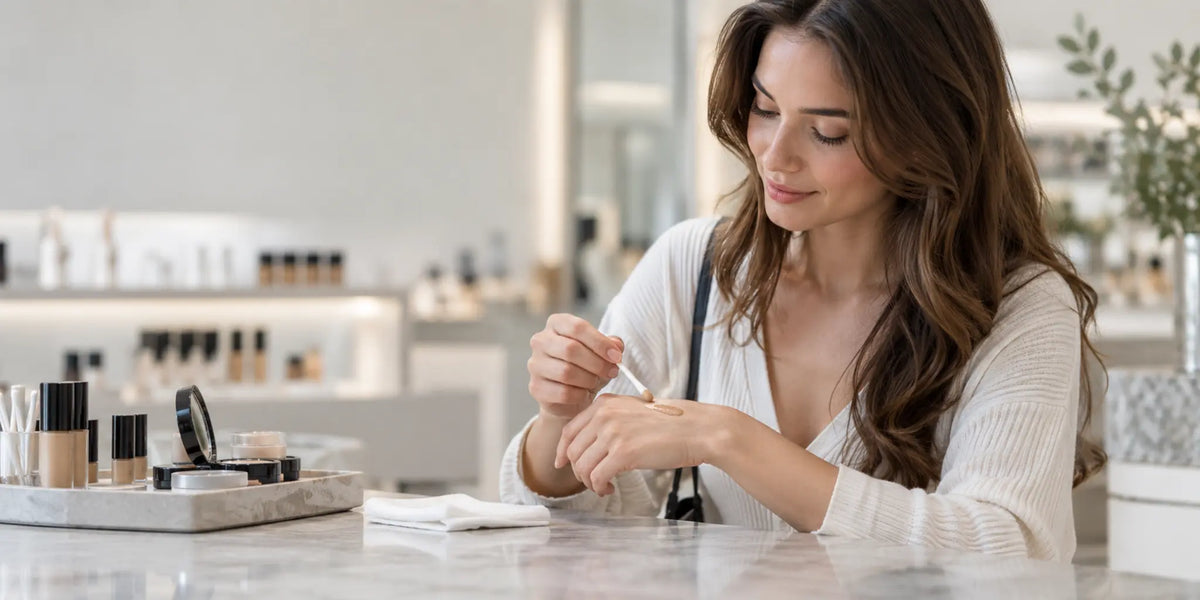
Should You Wash Your Face After Trying On Makeup in a Store?
Yes—if a store tester was applied to your face, remove it once you are finished wearing it, and always before bed. You do not need to rush to a sink when your skin feels comfortable, but you should use a fresh, label-compatible removal routine instead of leaving unfamiliar makeup on overnight. If the tester was only swatched on your hand or forearm, wash that area and your hands before touching your face or eating; a full face wash is unnecessary.
The most controlled option is to test makeup on the back of your hand with a fresh, unused applicator. The U.S. Food and Drug Administration specifically notes that makeup-counter testers are more likely to become contaminated and advises using a new, unused applicator or a fresh cotton swab if you test them.
Key Takeaways
- Use a fresh, unused applicator for every tester and never place a used wand, brush, or swab back into the product.
- A hand swatch does not require a full face cleanse; wash the swatched area and your hands before touching your face.
- If makeup was tested on your face, remove it when you are done wearing it and before bed, following the product label.
- Use lukewarm water, your fingertips, and a mild cleanser. Skip hard rubbing, rough cloths, and repeated washing.
Why In-Store Makeup Testing Is Back in the Conversation
Beauty shopping is becoming tactile again. Allure's 2026 Best of Beauty Live event, scheduled for October 17, centers product sampling and one-on-one makeup consultations alongside beauty education.
That makes a practical question newly relevant: what should you do after foundation, blush, eye color, or lip color from a shared retail environment touches your skin? The answer is not an elaborate reset. It is a careful test, a clear stopping point, and a gentle removal routine.
Before You Test: Make the Trial More Controlled
The FDA's cosmetics shelf-life guidance explains that testers can be exposed to more people and more contact than a product used at home. Its advice is direct: if you must test a product, use a new applicator or fresh cotton swab. The FDA also advises consumers not to share makeup and to keep containers clean in its cosmetics safety guidance.
| Situation | Better choice | Why it matters |
|---|---|---|
| You want to check color | Swatch on the back of your hand with a fresh, unused applicator. | It keeps the test away from the eyes and mouth and makes cleanup simple. |
| You need to see a face product in context | Ask staff about their tester procedure and request a fresh disposable applicator. | A staff member can dispense product without reusing a tool. |
| The wand or brush has already touched someone | Do not use it. Ask for a disposable option or skip the test. | Used tools can transfer material back to the shared tester. |
| You cannot find the label or directions | Pause until you can confirm the intended area and removal instructions. | Eye, lip, and face products are not automatically interchangeable. |
| The product looks or smells different from what you expect | Skip it and alert store staff. | A tester's history and storage conditions may be unclear. |

Should You Wash Your Face Right Away?
Not necessarily. Timing depends on where the product was placed, how your skin feels, and whether you plan to keep wearing the look. There is no advantage to repeatedly washing comfortable skin simply because you tried one product.
If you tested makeup on your hand or forearm
Wash the swatched area and your hands before touching your face, contact lenses, or food. A normal hand wash is enough for many washable formulas. If a formula remains, follow its label and use an appropriate makeup remover on the swatch rather than scrubbing.
If you tested makeup on your face
You may keep wearing it while your skin feels comfortable, then remove it when you are finished and before bed. If you tested several unfamiliar formulas, a simple end-of-day cleanse makes it easier to return to your usual routine. Our guide to washing before a makeup appointment explains how to begin with a predictable base, while the steps below focus on what to do afterward.
If you notice stinging or another unexpected reaction
Stop using the product and remove it gently. Follow the label's directions and warnings. If symptoms are serious or do not settle, seek advice from a qualified healthcare professional. For future purchases, consider a small-area test at home; this guide to testing a new cleanser shows how to introduce one unfamiliar product at a time.
How to Cleanse After Trying Makeup in a Store
Step 01—Confirm what you applied
Note the product type and where it was used. A face tint, eye formula, and lip color may have different removal instructions. Read the label before reaching for a remover, especially around the eyes.
Step 02—Wash your hands first
Use soap and water before touching your face. The FDA's microbiological safety guidance recommends washing hands before applying cosmetics and not sharing makeup.
Step 03—Loosen makeup only when the label calls for it
If the tested formula is designed to resist water, use a remover that its label allows. Work gently and give it time to lift. For area-specific examples, see our guides to removing waterproof eyeliner without rubbing and removing red lipstick without scrubbing.
Step 04—Use a mild cleanser with lukewarm water
The American Academy of Dermatology's face-washing advice recommends a gentle, non-abrasive cleanser, lukewarm water, and fingertips rather than a washcloth or sponge. Massage lightly; more pressure does not equal a better cleanse.
Step 05—Rinse and pat dry
Rinse thoroughly, then pat with a soft towel. Do not add extra cleansing rounds just to chase a squeaky feeling. If you wore a light complexion product, the skin-tint removal guide offers a similarly low-friction routine.

Where nooni Snowflake Whipping Cleanser Fits
If you want a straightforward rinse-off step, see nooni snowflake whipping cleanser. The current product page lists one 5.07 fl oz pack and directs users to wet their hands, lather a small amount with a little water, gently massage the damp face and neck for 10–15 seconds, rinse with warm water, and pat dry. It can be used morning or evening.
Important limitation: the product page does not identify this cleanser as a sanitizer for retail testers or promise removal of every face, eye, or lip formula. Use it only as labeled, avoid eye contact, and rinse well with water if it gets into the eyes.
What Not to Do After a Counter Try-On
- Do not return a used cotton swab, brush, or wand to a shared tester.
- Do not add water or saliva to change a product's texture.
- Do not scrub your face with a rough pad or towel.
- Do not layer several unfamiliar products if you want to understand how each one feels.
- Do not rely on a marketing phrase alone. Read the label, directions, warnings, and full ingredient declaration.
Claims also need context. The FTC's advertising substantiation policy says objective product claims should have a reasonable basis. At the counter, favor clear label information over broad promises.
Bottom Line
Wash your face after trying store makeup when the tester was applied to your face—but do it when you are finished wearing the product and always before bed, not through repeated emergency cleansing. For a hand swatch, wash the tested area and your hands. The strongest habits happen before application: use a fresh, unused tool, never double-dip, confirm the intended area, and read the label. Afterward, choose lukewarm water, light fingertip contact, and a short, familiar routine.
Sources
- U.S. Food and Drug Administration: Shelf Life and Expiration Dating of Cosmetics
- U.S. Food and Drug Administration: Using Cosmetics Safely
- U.S. Food and Drug Administration: Microbiological Safety and Cosmetics
- American Academy of Dermatology: Face Washing 101
- Federal Trade Commission: Policy Statement Regarding Advertising Substantiation
- Allure: Best of Beauty Live 2026
Related Reading
- Should You Wash Your Face Before a Makeup Appointment?
- How to Remove Skin Tint at Night Without Over-Cleansing
- How to Remove Waterproof Eyeliner Without Rubbing Your Eyes
Frequently Asked Questions
Select a question to open or close the answer.
Do I need to wash my whole face after testing one product on my hand?
No. Wash the swatched area and your hands before touching your face, contact lenses, or food. A full face wash is unnecessary when the tester never touched your face.
How soon should I remove makeup tested on my face?
If your skin feels comfortable, remove it when you are finished wearing it and always before bed. If you notice stinging or another unexpected reaction, stop using it and remove it gently.
Can I use a store's shared brush or wand?
Skip a brush or wand that has already touched another person or returned to the tester. Ask for a fresh, unused disposable applicator or a product dispensed by store staff.
Is a fresh cotton swab enough for a tester?
A fresh cotton swab follows FDA advice for testing cosmetics, provided it is used once and never placed back into the tester after touching your skin. Follow the product label and the store's tester procedure too.
What should I do if a tester feels uncomfortable?
Stop using the product, remove it gently, and follow the label's directions and warnings. If symptoms are serious or do not settle, consult a qualified healthcare professional.
Product & Skin Notice
This article is for general informational purposes only. Individual skin types, sensitivities, and results may vary. Always review the product label, ingredient list, directions, and warnings before use. Discontinue use if irritation occurs, and consult a qualified healthcare professional if you have an existing skin condition, known allergies, or persistent concerns.
Read more
A label-first guide to cleaning a cushion puff gently, rinsing away residue, drying it completely, and knowing when it is time to replace it.
Remove temporary face tattoos with less rubbing by checking the label, softening the decal as directed, and cleansing residue gently afterward.